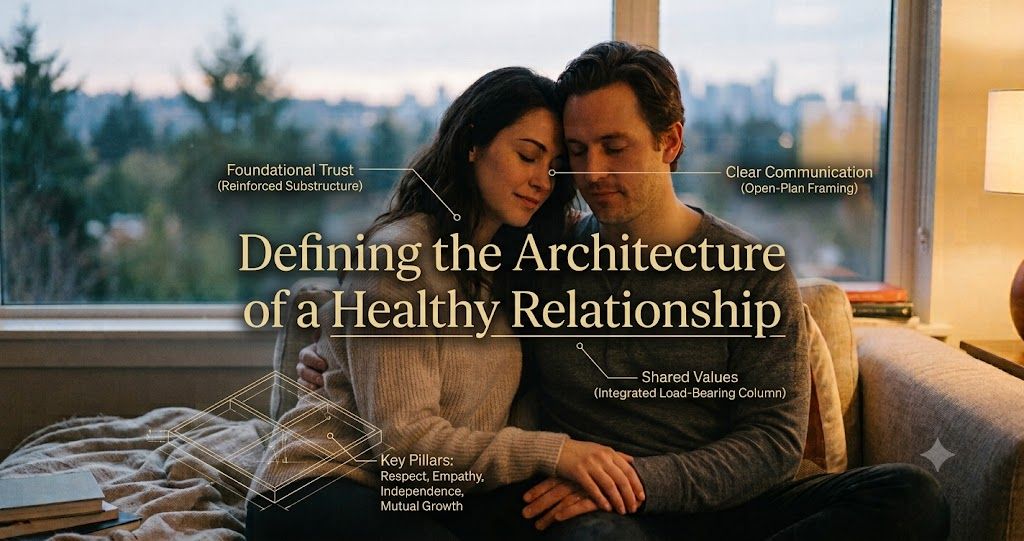
In the modern landscape of romance, we are often sold a sanitized, curated version of "health." We see it in the highlights—the cinematic sunsets, the effortless laughter, and the polished aesthetic of a couple "in sync." However, for the mature adult seeking a deep, enduring connection, a healthy relationship is not a static state of perfection; it is a dynamic, living architecture. It is a sanctuary built not on the absence of conflict, but on the presence of a shared foundation, a common language, and the profound resilience to weather the shifting seasons of life together.
To understand what a healthy relationship looks like, we must look beneath the surface of "getting along" and examine the deeper mechanics of trust, autonomy, communication, and the enduring pulse of intimacy.
If a relationship were a house, trust would be the bedrock. It is the structural integrity that allows both partners to move freely within the space, knowing the ground beneath them will not give way. In a healthy partnership, trust is synonymous with psychological safety. It is the profound confidence that your partner is a "safe harbor" for your vulnerabilities.
When trust is robust, you no longer feel the need to curate your life or edit your thoughts before speaking. It means that when you share a fear, a secret, or a "messy" truth, you do not have to worry it will be used as leverage against you. This safety is cultivated in the micro-moments: the consistent reliability of their presence, the way they hold space for your bad days, and the steady rhythm of their support. It is the difference between a connection that feels like a performance and one that feels like home.
One of the most vital nuances of a mature relationship is the distinction between being "enmeshed" and being "connected." A common pitfall is the belief that two people must become one to be healthy. In reality, the most vibrant relationships are those where two whole individuals choose to share a life.
Healthy relationships thrive on "connected autonomy." This is the ability to be deeply tethered to your partner while remaining firmly rooted in your own identity. It is the celebration of your separate passions, your independent friendships, and your personal growth. In a healthy dynamic, your partner is not your only source of identity; they are your companion in the exploration of it. This balance ensures that the "we" is fueled by two distinct, vibrant "I's," preventing the exhaustion of codependency and replacing it with the vitality of a partnership of equals.
Many people mistake communication for the mere exchange of information—logistics, plans, and daily updates. While these are necessary, they are not the heart of intimacy. In a healthy relationship, communication is an art form: it is the intentional creation of shared meaning. It is the transition from speaking at one another to listening to one another.
This requires a high level of attunement—the ability to hear the nuance behind the words. It means recognizing the fear in a sharp tone or the longing in a silent pause. It involves the courage to speak your truth clearly and the humility to listen to your partner’s truth with an open heart.
Crucially, a healthy relationship does not avoid conflict; it engages with it constructively. When disagreements arise, the goal isn't to "win" or to prove the other person wrong; the goal is to understand the root of the pain and to find a path forward that honors both. It is the move from "Me vs. You" to "Us vs. The Problem." It is the ability to pause when tempers flare, breathe, and choose a response rooted in kindness rather than a reaction born of defense.
While often discussed as a single concept, intimacy in a healthy relationship is actually a tapestry woven from three distinct, yet intertwined, threads:
Emotional Intimacy is the "why" of the connection. It is the feeling of being truly seen and accepted. It is the vulnerability of sharing your inner world—the parts of you that aren't always polished or ready for public consumption. It is the deep comfort of being known, and the profound peace of being loved for that very self.
Physical Intimacy is the "how" of the connection. While it includes the passionate chemistry of sex, it also encompasses the quiet, everyday ritual of touch. It is the grounding weight of a long hug, the steady presence of a hand held in a crowd, and the way your body recognizes your partner’s presence as a place of rest. It is the non-verbal language of "I am here with you."
Intellectual Intimacy is the "what" of the connection. It is the shared joy of discovery and the spark of discussing ideas, debating philosophies, or simply marveling at the world. It is the respect for the way your partner thinks and the thrill of finding a mind that challenges yours.
In a healthy relationship, these three strands are in balance. They nourish one another, ensuring that the relationship is intellectually stimulating, emotionally safe, and physically fulfilling.
Human beings are not static. We are constantly evolving, and a healthy relationship is a dynamic system that can accommodate this growth. Life will inevitably bring transitions—career shifts, moves, the arrival of children, or the nuanced challenges of aging.
A healthy relationship is one that can bend without breaking. It is a partnership where both individuals feel encouraged to evolve. When one partner pursues a new passion or experiences a personal transformation, the other doesn't see it as a threat to the status quo but as a journey they are honored to walk alongside. It is the ability to look at each other and say, "I love who you are today, and I am excited to see who you will become tomorrow."
Sometimes, the health of a relationship isn't found in the grand gestures, but in the subtle, consistent indicators of a thriving connection:
Playfulness: The ability to laugh together and find joy in the mundane.
Appreciation: The active practice of noticing and vocalizing what you love about each other.
Safety: The feeling that you can be your truest self without the need for a mask.
Respect: Honoring each other's boundaries, time, and individuality.
Consistency: The reliability of your partner’s presence and their commitment to the "we."
Ultimately, a healthy relationship feels like home. It isn't that the relationship is always peaceful; there will be storms, and there will be days when the path forward feels obscured. However, "home" means that no matter how demanding or chaotic the world outside becomes, the space between the two of you remains a sanctuary.
It is a place where you can let your guard down. It is a space where you are not performing, but participating. It is the profound, soul-deep realization that you have found a person who sees your complexities, honors your truth, and chooses you—every single day—as your partner in the magnificent, messy, and beautiful adventure of life. A healthy relationship is not something you simply find; it is a masterpiece you create together, one honest word and one intentional touch at a time.





Comments 0
Leave a Reply ↓No comments yet
Be the first to share your thoughts, insights, or ask a question about this article!
Leave a Reply
Your email address will not be published. Required fields are marked with *