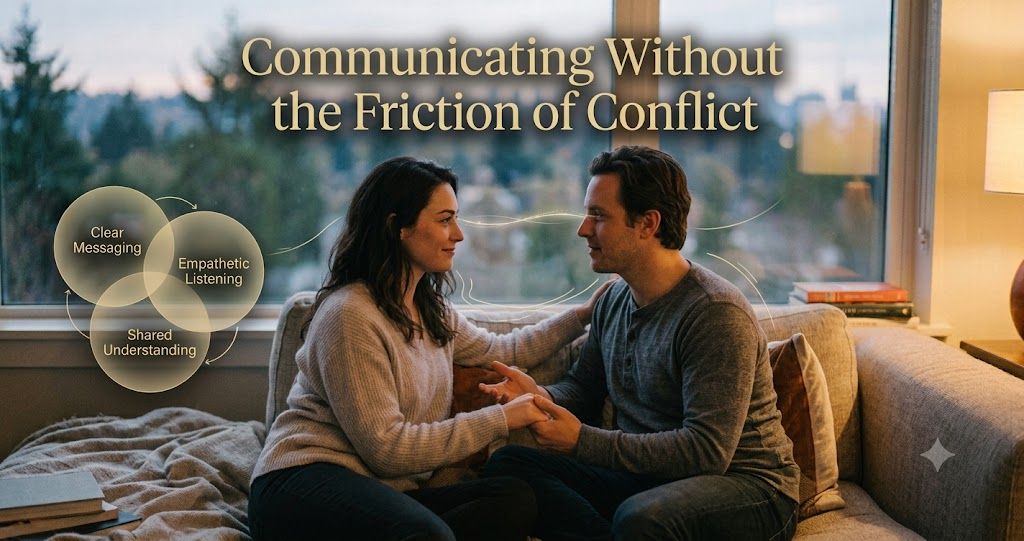
In any long-term partnership, there will come moments when the air grows heavy—moments when a grievance takes root, a frustration mounts, or a misunderstanding begins to simmer. In those moments, the natural instinct is often to "fight" for our point of view. We sharpen our words, prepare our defenses, and ready our rebuttals. But in the architecture of a mature relationship, the goal of communication is never to win a point; it is to bridge a gap. When we prioritize "winning," we often end up winning a victory at the expense of the connection.
To communicate without starting an argument is to move from a posture of combat to a posture of curiosity. It is the art of stripping away the armor of "I’m right" to reveal the vulnerability of "I need to be understood." It is about learning to speak in a way that invites your partner in, rather than pushing them away.
To master this, we must look at the components of the craft: the distinction between needs and demands, the power of the "I" statement, the discipline of the pause, and the intentionality of the "soft start."
Most arguments begin not with a disagreement over facts, but with a clash of unmet needs. When we react with anger, it is often a "smoke signal" for a deeper, more vulnerable fire. For example, when a partner reacts sharply about a forgotten chore, the immediate argument is about the chore. However, the underlying need is often a desire to feel valued, seen, or supported.
To communicate without the friction of conflict, we must first do the inner work of identifying our own "why." Before bringing a topic to the table, ask yourself: What is the core need I am trying to express? Is it a need for reassurance? A need for more time? A need to feel respected? When we communicate from a place of need rather than a place of accusation, the tone shifts. Instead of "You never help me," the expression becomes "I’m feeling overwhelmed and would love some extra support today." By focusing on the need, we move from attacking the person to inviting them to support our well-being.
The most fundamental tool in the kit of mature communication is the "I" statement. This isn't just a linguistic trick; it is a profound shift in accountability. When we start a sentence with "You," we are pointing a finger. "You made me feel ignored," "You always forget," "You never listen." These are declarations of the other person’s failings. Because they feel attacked, their natural biological response is to defend themselves, and the cycle of "the argument" begins.
An "I" statement, however, keeps the focus on your internal experience. It is the act of taking ownership of your feelings. "I feel lonely when we don't spend time together," or "I feel overwhelmed by the current pace of our schedule." When you speak from your own experience, your partner cannot argue with your feelings. They aren't being accused; they are being invited to witness your internal world. This creates a safe container for the truth. You are not telling them they are doing something wrong; you are telling them something you are experiencing.
Conflict often escalates not because of what is said, but how it is said. Our voices can become sharper, our gestures more pronounced, and our words more cutting as our internal stress levels rise. In these moments, the prefrontal cortex—the part of the brain responsible for logic and empathy—begins to shut down, and the amygdala takes over.
The most sophisticated way to avoid an argument is to recognize when you have entered this "red zone" and choose to pause. A pause isn't an avoidance of the issue; it is a commitment to the relationship. It is the ability to say, "I’m feeling very frustrated right now and I want to make sure I speak to you with the love you deserve. Can we take twenty minutes to breathe and come back to this?"
This allows both partners to regulate their nervous systems. When we are calm, we can hear the nuances of each other’s words. When we are flooded, we can only hear the perceived threat. The pause is a gift you give to the relationship, ensuring that the conversation remains a bridge rather than a battlefield.
Research in relationship psychology suggests that the first three minutes of a difficult conversation often determine its outcome. This is the "soft start." It is the way you introduce a difficult topic into the room. A hard start is an explosion: "We need to talk about how you're always late." It puts the other person on the defensive instantly.
A soft start is an invitation. It is a gentle way of opening the door. It begins with a statement of your own feelings or a statement of your commitment to the "we." For example: "I love our time together, and I’ve been struggling with how to bring up something that’s been on my mind," or "I’m feeling a bit disconnected lately and I’d love to talk about how we can get some more quality time together."
A soft start validates the relationship before it even addresses the problem. It tells your partner, "I am on your team." It lowers the stakes and allows them to listen with an open heart.
Communication is not just about what you say; it is about what you receive. One of the most effective ways to prevent a conversation from turning into an argument is to practice active listening. This means listening not to find a rebuttal, but to seek understanding.
When your partner speaks, your goal is to mirror back what you hear. "What I hear you saying is that you’re feeling exhausted by the daily routine and you need more moments of intentional connection. Is that right?" This serves two purposes: it ensures you actually understand them, and it makes them feel heard. When a person feels truly heard, their need to "fight" to be understood diminishes. They don't need to raise their voice if they can feel the resonance of your understanding.
Ultimately, the reason we communicate is to build a shared world. Every time we choose to speak from our needs, to use "I" statements, to pause when we are flooded, and to start with a soft opening, we are reinforcing the architecture of intimacy.
We aren't trying to avoid "hard" conversations. Hard conversations are necessary; they are the forge in which trust is tempered. However, we want to engage in those conversations as allies. We want to approach the problem as a team, standing on the same side of the table.
When we communicate in this way, we move away from the primitive "fight" and toward a sophisticated, meaningful exchange. We begin to see that the goal isn't to change the other person's mind; it is to share our hearts with them. And when we do that, we find that the most profound connection is not found in the silence of things left unsaid, but in the safe, open space where the truth can be shared without the sting of conflict.
In the end, the most beautiful thing about high-level communication is that it fosters a deep, enduring sense of safety. It tells your partner, "Your feelings are safe with me, and my truths are safe with you." It is the ultimate expression of respect—a commitment to understanding one another, no matter how complex the terrain may be.





Comments 0
Leave a Reply ↓No comments yet
Be the first to share your thoughts, insights, or ask a question about this article!
Leave a Reply
Your email address will not be published. Required fields are marked with *