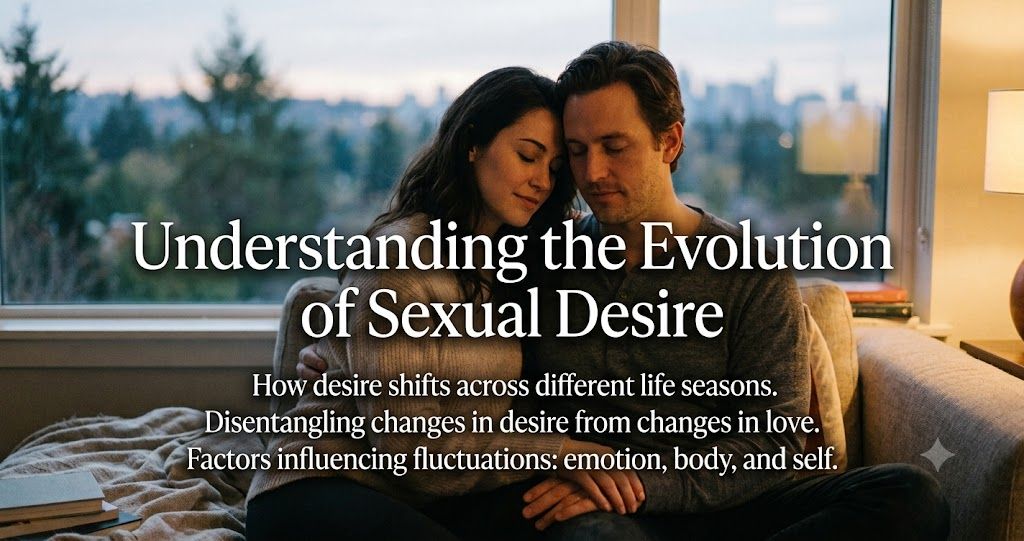
In the sanctuary of a long-term partnership, one of the most common sources of silent anxiety—and often, deep heartache—is the fluctuating nature of desire. We are frequently taught to believe that desire is a steady, unwavering flame: once lit by the spark of initial attraction, it should burn with a constant, predictable intensity. However, the lived experience of mature intimacy reveals a far more nuanced truth. Desire is not a constant; it is a conversation between the body, the mind, and the circumstances of our lives. It is a living, breathing ecosystem that responds to the "weather" of our internal and external worlds.
When desire shifts, it is rarely a signal of a failing connection or a broken heart. Instead, it is often an invitation to look closer. It is a signal that something in our biological chemistry, our mental architecture, or our relational narrative is moving. To understand why desire changes, we must move away from the "problem-solving" mindset and toward a deeper, more compassionate exploration of the three primary architects of our internal world: the biological, the psychological, and the relational.
The first layer of desire is the foundation of our physical existence. Our bodies are not static machines; they are dynamic systems that communicate through a complex chemistry of hormones and sensory feedback. When we speak of "biological changes," we aren't merely discussing medical facts; we are talking about the way our bodies signal their state of health, stress, and transition.
For many, the shifts in hormones—be they the monthly cycles of estrogen and progesterone, the transition into perimenopause, or the steady changes in testosterone—impact the "engine" of desire. These changes can affect everything from physical comfort and energy levels to the way the body responds to touch. It is vital to view these as biological responses rather than personal failings. When a body is navigating a hormonal shift, it may be seeking different types of engagement, a different pace, or simply a period of rest.
When we approach these changes through the lens of "why is my body doing this?" rather than "what is wrong with me?", the narrative shifts. We move toward a space where both partners can advocate for each other’s physical comfort, finding new ways to navigate the changing terrain of their physical experience with grace and patience.
If biology is the ground upon which we stand, psychology is the atmosphere in which we breathe. Often, what we perceive as a drop in sexual desire is actually a surge in mental load. In our fast-paced, high-demand world, many adults are living in a state of constant "alert." We are managing careers, households, finances, and the emotional labor of parenting.
When the brain is in a state of high-arousal—calculating the next task, worrying about a deadline, or managing the complexities of daily logistics—it enters a survival mode. In this state, the brain prioritizes "utility" over "luxury." It is difficult for the mind to transition from "manager" to "lover" when the mental tabs of the day are still left open.
A "dimmed" desire in this context isn't a lack of love; it is a lack of mental bandwidth. The noise of life has become so loud that it has muffled the whispers of desire. Recognizing this allows a couple to move away from the question of "why don't you want me?" and toward the more supportive inquiry of, "how can we create a space where you can hear yourself again?"
There is a profound difference between the spark of a new relationship and the warm glow of a long-term partnership. In the early stages of dating, desire is often fueled by the "thrill of the new"—a dopamine-driven response to the unknown. As a relationship matures, the fuel source must shift from the adrenaline of discovery to the intimacy of the known.
In a long-term commitment, it is easy for the "predictability" of a shared life to be misinterpreted as stagnation. However, when we peel back the layers, we often find that what is actually missing is not desire itself, but the novelty of the experience. When the routine becomes so heavy that it feels like a weight, it can stifle the imagination.
When desire shifts in a long-term relationship, it is often an invitation to innovate. It is a call to find new ways to be "interested" in one another. It might mean finding ways to introduce new elements into your shared life—new experiences, new ways of communicating, or simply intentional moments of "unplugging" from the roles of parent, provider, or professional. It is about moving from a "static" desire to a "dynamic" one, ensuring that the hearth of your connection remains warm and inviting.
Our identity is not a fixed point; it is a journey. We occupy different roles at different times, and these roles demand different energies. For many, the transition into parenthood, the pursuit of a demanding career, or the experience of significant loss can fundamentally shift how one experiences desire.
When we move into a new season of life, our identity shifts. A woman who becomes a mother may find that her primary "role" for a time is one of nurturing and protection, which can leave less room for the more "expansive" feelings of romantic pursuit. A man may find his identity so tied to his role as a provider that his internal reservoir for exploration feels depleted.
These are not "barriers" to intimacy; they are reflections of the reality of your lives. When our roles change, our ways of experiencing desire must also evolve. It may mean finding more frequent, shorter bursts of connection; it may mean finding joy in the "mundane" intimacy of a shared glance; or it may mean a profound, shared commitment to protecting the "us" from the encroachment of the "they."
Perhaps the most important takeaway in the study of changing desire is that it provides a map of the internal world. When desire fluctuates, it is a request for deeper communication. It is an invitation to speak about the things that are hard to say.
When we move toward a "soft" exploration of these changes, we are choosing to be allies. Instead of viewing a dip in desire as a problem to be solved by "doing more," we treat it as a topic to be understood. By using "I" statements and leading with curiosity, we can begin to map the terrain together.
“I’ve noticed that things have felt a bit different lately, and I’m wondering how you’re feeling about our connection.”
“I’ve been feeling a bit overwhelmed by my work lately, and I think it’s making it harder for me to step into my more intimate side.”
These are not just questions; they are gestures of intimacy. They say, I see you, and I want to understand your experience.
The most profound truth about sexual desire is that it is not a steady-state fact to be "fixed" or "broken." It is a reflection of your current state of being. It changes because you are changing. You are moving through different seasons, navigating different pressures, and experiencing the ongoing evolution of your own body and mind.
To have a desire that ebbs and flows is not a sign of a fading flame; it is a sign of a living one. It requires you to be patient, to be observant, and to be deeply, radically curious about your partner. It is about learning to dance in different rhythms—sometimes a fast-paced, high-energy dance, and sometimes a slow, deep, and quiet sway.
By moving away from the judgment of "why" and toward the discovery of "how," you can navigate these shifts with grace. You find that even when the spark seems to dim in one area, the hearth remains warm in another. You aren't just seeking to "fix" a feeling; you are seeking to deepen the bond. And in that depth, you find that the most enduring intimacy isn't found in the constant height of the flame, but in the unwavering warmth of the fire you tend together.




Comments 0
Leave a Reply ↓No comments yet
Be the first to share your thoughts, insights, or ask a question about this article!
Leave a Reply
Your email address will not be published. Required fields are marked with *